
Key Takeaways
- Out of the blue losses in manufacturing expenses are up to 50 billion every year.
- Predictive maintenance is able to reduce down time and cost of maintenance significantly.
- In this case, the real-time monitoring, which is provided by IoT, improves the productivity and efficiency of operations.
Understanding the Impact of Equipment Downtime
Unexpected outage is one of the most tenacious and expensive issues in the manufacturing industry. When factory equipment stalls in the middle of the action, manufacturers are able to lose hundreds of hours every year and it takes only a few years to add up to billions of dollars in losses throughout the industry. The companies such as C&B Equipment have become the significant stakeholder that enables manufacturers to reduce such disruptions by proposing maintenance solutions that focus on ensuring reliability. Even a short off-the-record break may break the production plans, damage client relations, and lower the profitability level.
Manufacturing downtimes lead to delays, disruptions in the supply chain, and tarnishing of reputation, compelling managers to focus on reliability. Through data analysis, plants discover root causes and come up with strategies that focus on maintenance, training and technology. Predictive maintenance minimizes the surprise failures, whereas experienced operators enhance the detection and responsibility. Other influences on performance include the environment in the form of dust, temperature, and humidity among others and sensors and controls are necessary in the maintenance of equipment in their optimum condition.
Adopting Predictive Maintenance Strategies
The introduction of predictive maintenance is also increasingly becoming the reliance of pioneering companies as they seek to surpass the old ways of having calendar-based plans of maintenance. This is a data-driven method whereby interventions are scheduled on the basis of the actual state of assets as opposed to periodical scheduling. The advantages are critical: concentration of resources on appropriate equipment at the appropriate time will lead to the fact that plants will have fewer interruptions and prolong the life of important property.
- Less Downtime: With the prediction of failures of equipment, proactive maintenance reduces downtime, meaning that a company will not run out of production.
- Cost Savings: The problem detection in its early phases restricts the magnitude and the cost of repairing the product and minimizes the needless replacement of different parts.
- Long Lifespan of Equipment: Constant maintenance and management will increase the life of expensive equipment to its fullest possibility, increasing the payback period.
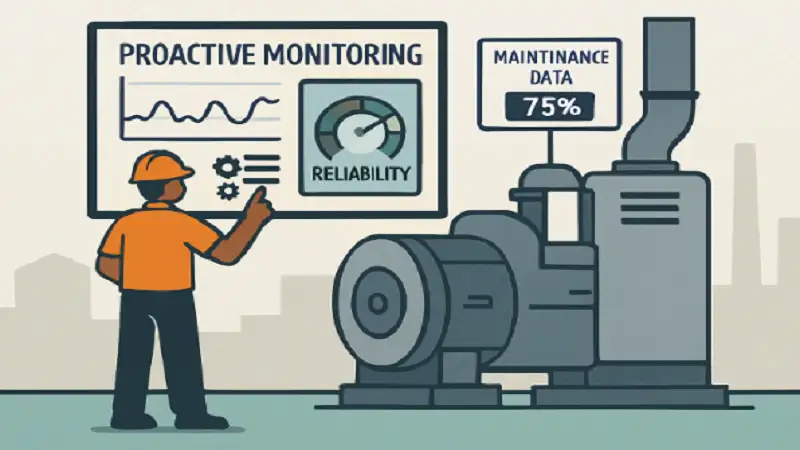
Organisations that make use of predictive maintenance can save up to 25 percent and raise the availability of assets up to 15 percent. It has been enabled by combining superior analytics and machine learning models with sensors on equipment and data platforms.
Using real-time monitoring with IoT
The IIoT is transforming equipment monitoring business principles. Integrating sensors, controllers and cloud-based software, the IIoT solutions enable the operators to have total visibility of asset health, its utilization rates, and performance trends at all stages of its life. These capabilities enable:

- Detection and Immediate Response to Problems: Inbuilt smarts and automatic alerts allow resolving problems in time, so the reaction time is shorter and the safety level is higher.
- Data-Driven Decisions: Sensor data can be aggregated to make advanced analytics, and further help organizations refine their maintenance schedules and make effective investment choices.
- Improved Productivity: As production is optimized in terms of timing, energy use, and improved processes, due to continuous monitoring of condition, the manufacturers can improve their production levels.
Alliance Workforce Development and Trainers
Human factors are still paramount in the attainment of world-class reliability. Technical training keeps the operators in step with the latest procedures and technologies as well as the maintenance technicians. Experienced employees are able to identify anomalous alterations like machine abnormal vibrations or temperature deviations well before the automatic diagnostics raises the red flag. The development of a comprehensive workforce also produces team members that not only perform their maintenance duties well, but they also learn the bigger concepts of reliability. The benefits of this culture of knowledge-sharing in the site morale, working safety, and talent retention are very high in the long-term.
Creating a Culture of Continuous Improvement
State-of-the-art manufacturing facilities create the culture of reliability and operational excellence being constant life objectives. This begins with the regular reviewing of the maintenance and operational standards in terms of actual performance, latest studies and employee responses. Flexibility within the organization in enabling workers at all levels to play a role in the improvement of the processes brings realistic and lasting positive achievements. Companies with a culture of constant improvement will be more innovative, employee engagement will be increased and long term performance will be more robust. Investment in new technologies – AI-based analytics and robotics will see to it that the plants retain their competitive advantage in the face of the active development of industry standards.
Conclusion
Therefore, in the current competitive manufacturing environment, the need to increase the uptime and reliability of the equipment and plants is a competitive advantage. Organizations can greatly decrease downtime, enhance their productivity and improve their reputation in the market by adopting predictive maintenance, making use of IIoT solutions, retaining a superbly trained labor force and having a culture of continuous improvement.